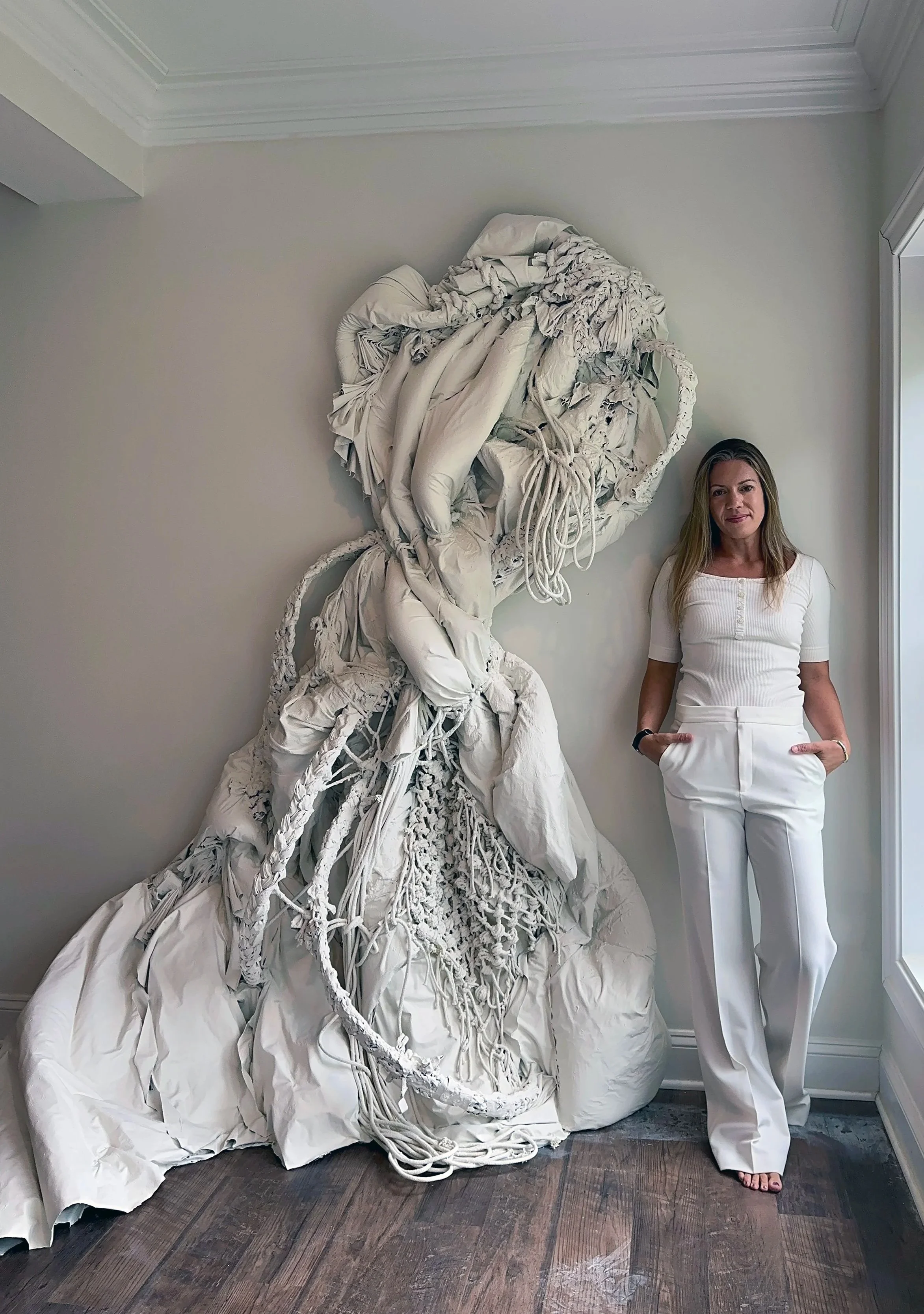
Artist statement
Through the tactile, repetitive work of pleating, binding, stitching, wrapping, and layering fabric, I feel present and alive. Creating sculpture gives me a place to be most fully myself.
I first found that place as a child in the woods and wetlands of southern Georgia. I built forts beneath tall pines, searched for arrowheads, animal tracks, feathers, and berries, imagined fairies dancing through fern-covered creek beds, and swam in ponds with water too dark to see beneath the surface. The landscape held me. I felt free to wonder, explore, discover, and create. Nature was my world. My sculptures are born from a longing to return.
The material language I use to build them comes from smocking, inherited through my maternal line. My grandmother hand-smocked the dresses I wore from infancy through childhood, so I first knew the technique against my own body before I understood how the dresses were made. As a child, I also discovered a pink silk-ribboned box in my grandmother’s attic, a treasure chest filled with fragments of hand-tatted lace, monogrammed handkerchiefs, and unfinished pieces of handmade garments, all made by my ancestors and tucked away with extraordinary care. These remnants were magic clues to the women who came before me, and I felt connected to them through these delicate, beautiful pieces of cloth.
In my twenties, I learned how to smock baby dresses and then adapted the technique into headbands, cuff bracelets, belts, and pillows. In my thirties, I ran an impromptu experiment in my painting studio. I hand-pleated and smocked some extra fabric without a pleater, a pattern, or the careful rules of traditional smocking. I tossed the experiment into a corner, but continued exploring pleated and smocked fabric in my painting practice, building it onto and beyond the canvas until the work pushed fully into space. Five years later, it struck me to pull that first experiment back out and paint it gold. Suddenly, I saw it as a complete object—an artwork in its own right. That piece became Shield, and it changed the way I understood what fabric could do.
Smocking taught me how to make fabric hold structure, but sculpture began when I broke its rules. I abandoned hems, seams, patterns, pleaters, and the logic of the garment, keeping only what I needed: my hands, the cloth, and the knowledge of how pleating and cable stitch could create compression, density, volume, elasticity, and surface. Freed from its traditional uses, the technique became instinctive and raw. I could use it not to decorate cloth, but to transform cloth into object. I continue to push its possibilities, allowing orderly handwork to become irregular, organic, architectural form.
Each sculpture emerges slowly through physical handwork, holding the accumulated gestures and attention of its making. Sending it into the world feels less like completion than release: what began as a place for me might become a place for someone else.
I offer these sculptures as invitations to those who encounter them—not to step into my world, but more fully into their own.
ARTIST ALL THE WAY.
Annie Broderick is a Washington, DC–based sculptor whose work explores place, memory, and inheritance. Rooted in the needlework traditions passed through generations of women in her maternal family, she creates immersive textile and mixed-media sculptures that merge contemporary abstraction with deeply personal histories, inviting close attention and rewarding sustained looking.
Trained as a painter at Davidson College and as a copyist at the Louvre Museum in Paris, Broderick brings a painter's sensitivity to surface, light, and gesture to her three-dimensional work. Her work has been featured in DC Modern Luxury and exhibited in galleries, art fairs, and public spaces throughout the Washington region, with pieces held in private and corporate collections across the United States, including permanent installations at the American Express Centurion Lounge at Reagan National Airport.
Broderick serves on the Board of Directors of the Workhouse Arts Foundation.